How to Find the Daily Office
Daily prayer is distinct from the Sunday mass. Anyone can pray it, and this is your invitation in!
The service itself is easy. Finding today's psalms and readings is the fiddly part. It takes four answers, and you gather them from different parts of the book.
It should also be noted, that for a lay-person, there's not actually a wrong way to do it, this post however, describes the BCP method, if you want to align with tradition and do it the BCP way. Feel free to skip bits if it's too long, add your own prayers, and otherwise modify to suit your lived and real daily practice. I find it interesting to at least be aware of the Kalendar, and conventions that have been pulled up through the ages.
The four offices
| Office | Rite One | Rite Two |
|---|---|---|
| Morning Prayer | p. 37 | p. 75 |
| Noonday Prayer | — | p. 103 |
| Evening Prayer | p. 61 | p. 115 |
| Compline | — | p. 127 |
- Rite One is Tudor English and Rite Two is modern. Neither one is harder than the other.
- Morning and Evening Prayer carry the psalms and readings, so they need the lookup below.
- Noonday Prayer and Compline are short and fixed. No lookup. You turn to the page and read.
- Daily Devotions for Individuals and Families, p. 136, gives four very short forms. Also no lookup.
The lookup
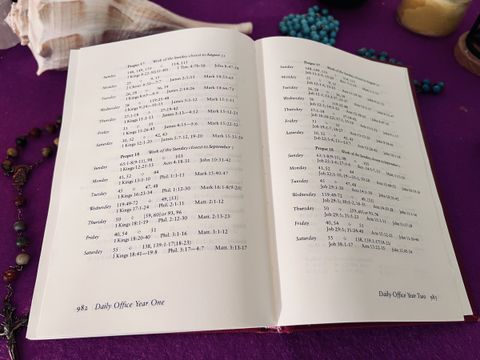
Morning and Evening Prayer both reach a point where the book asks for the appointed psalms and lessons without telling you what they are. You find them in the Daily Office Lectionary, p. 934. It takes four steps.
1. Which year — One or Two?
- The Office runs a two-year cycle.
- The Sunday eucharistic lectionary runs a three-year cycle (A/B/C). The two are unrelated and they do not line up.
- The cycle turns over at Advent. It does not follow the calendar year.
- Rule: Year One begins on the First Sunday of Advent preceding an odd-numbered year.
That last sentence is the one that trips people up, so let's take it apart.
A church year opens on the First Sunday of Advent, in late November or early December, and it closes the day before the next one opens. So it sits across two calendar years. About one month of it falls in the first year and eleven months fall in the second. The lectionary has to call each cycle something, so it uses the name of the calendar year that holds most of it. That is the year the church year runs into. So "the Advent preceding an odd-numbered year" just means the Advent that leads into an odd year. The number you check is on the far side of Christmas. It is not the year printed on the Advent Sunday itself.
| Church year | Runs into | Office year |
|---|---|---|
| Sun 1 Dec 2024 to Sat 29 Nov 2025 | 2025, odd | One |
| Sun 30 Nov 2025 to Sat 28 Nov 2026 | 2026, even | Two |
| Sun 29 Nov 2026 to Sat 27 Nov 2027 | 2027, odd | One |
| Sun 28 Nov 2027 to Sat 2 Dec 2028 | 2028, even | Two |
Try the middle row against a real date. As this is written, in August 2026, the Office is in Year Two. The year now running opened at Advent 2025 and runs into 2026, which is even. It stays Year Two through Saturday 28 November 2026. Year One begins at Morning Prayer on Sunday 29 November 2026. That is five weeks before 2027 starts, even though 2027 is the year it is named after.
2. Which week?
The lectionary is organized by week. Each week is named for the Sunday just past.
2a. Advent through Easter. The names are what you would expect: "Week of 2 Advent," "Week of 4 Easter." You can read them straight off.
2b. Season after Pentecost — the anchor dates.
Each week in this season has two names printed together on one line: Proper 17, and Week of the Sunday closest to August 31. They mean the same week. The Proper number is there so you can cross-reference the Sunday eucharistic lectionary. The date form is the rule that tells you which week you want.
The snag is that date. It is not the date of the Sunday. It is an anchor, and the Sunday it points to can land up to three days on either side of it. They only fall on the same day once every few years.
So don't scan the headings for the date you are holding. That is the natural thing to do and it will not work. Find the Sunday just past, then find the printed anchor date nearest to it. That heading is your week.
Worked example: the Sunday just past is 30 August 2026. The nearest anchor printed in the lectionary is August 31, so the week is Proper 17 · Week of the Sunday closest to August 31, in Office Year Two. We will carry that through to the readings below.
3. Which day?
Read down the week to today's weekday. That row is the day's appointment.
4. Morning or evening?
- Psalms are printed morning group first, evening group second.
- The psalm text is in the prayer book itself, in the Psalter, p. 585, rather than in a Bible. The asterisk in the middle of a verse marks where you breathe.
- The collect on a weekday is the collect of the preceding Sunday. Collects begin at p. 159 (Traditional) / p. 211 (Contemporary).
The three readings
Three readings are appointed for each day. How you spread them across the offices is up to you (p. 934):
- Two in the morning, one in the evening; or
- All three together, if the Office is prayed once that day.
- The book suggests reading the Gospel in the evening in Year One and in the morning in Year Two.
- If you want two readings at both offices, the fourth comes from the other year: its Old Testament reading leads Evening Prayer.
- When more than one is read at an Office, the first is always Old Testament or Apocrypha.
Things the rubric explicitly allows:
| Notation | Meaning |
|---|---|
| ( parentheses ) | Optional lengthening of a reading |
| [ brackets ] | May be omitted, but if you are praying the whole Psalter you use the bracketed psalms instead of the alternatives |
- Psalms appointed for any day may be used on any other day in the same week, except on major holy days.
- You can swap the morning and evening psalms if you want.
Two exceptions
Eves. Some evenings take their office from the next day's feast, because the feast begins at sundown. On 24 December, Morning Prayer comes from the weekday of Advent 4 and Evening Prayer comes from Christmas Eve. The same thing happens before the Holy Name, the Epiphany, Ascension and Pentecost.
Holy days interrupt. A major feast has its own readings and pushes the week's sequence aside. The rubric tells you to lengthen, combine or omit readings afterward to get back on track.
All four steps, on one day
Monday, 31 August 2026, by hand, with the book open.
1. Which year? The church year running on that date opened at Advent 2025. Year One begins at the Advent preceding an odd-numbered year, and Advent 2025 leads into 2026, which is even. So we want Year Two, and we can ignore the Year One column.
2. Which week? The Sunday just past is 30 August, which is after Pentecost, so 2b applies. There is no heading for August 30. The lectionary only prints anchor dates. The nearest anchor to 30 August is August 31, so the heading we want is "Proper 17 · Week of the Sunday closest to August 31." Monday is under it.
3. Which day? Read down that week to Monday.
4. Morning or evening? The Monday row gives one psalm group, then a second, then three readings: Psalm 25 · Psalms 9, 15 · Job 12:1-6, 13-25 · Acts 11:19-30 · John 8:21-32.
That leaves the distribution. We have three readings and two offices. Year Two suggests the Gospel in the morning, and when more than one reading is used at a single office the first has to be Old Testament or Apocrypha. So Job leads the morning, John follows it, and Acts goes to the evening:
| Morning Prayer | Evening Prayer | |
|---|---|---|
| Rite Two | p. 75 | p. 115 |
| Psalms | 25 | 9, 15 |
| First reading | Job 12:1-6, 13-25 | Acts 11:19-30 |
| Second reading | John 8:21-32 | — |
This is only one possible arrangement. You could do all three in the morning if you wanted, or read Acts in the morning and John at night. The rubric leaves it open.
Two things left to check, and neither one changes anything here. 31 August is not an eve, so nothing borrows Monday's evening. The calendar does commemorate Aidan of Lindisfarne that day, but a commemoration is not a major feast. It does not displace the week's sequence, so the Office is prayed as above. The collect is Sunday's, carried forward. That is the collect of Proper 17, on p. 159 (Traditional) or p. 211 (Contemporary).
Psalm text from the Psalter, p. 585. The readings are read from a Bible.
Shortcuts
It is a four-input table lookup, which means a computer can do it for you.
- Kalendar is ours. It is one of the tools we build in the Workshop here on The Common Wild. You click a day and it gives you the year, the week, the morning and evening psalms, and all three readings with the text.
- Kalendar; References Only
- The Lectionary Page
- Mission St. Clare
It is worth doing by hand two or three times first. You start to see the shape of the year in the lookup itself.